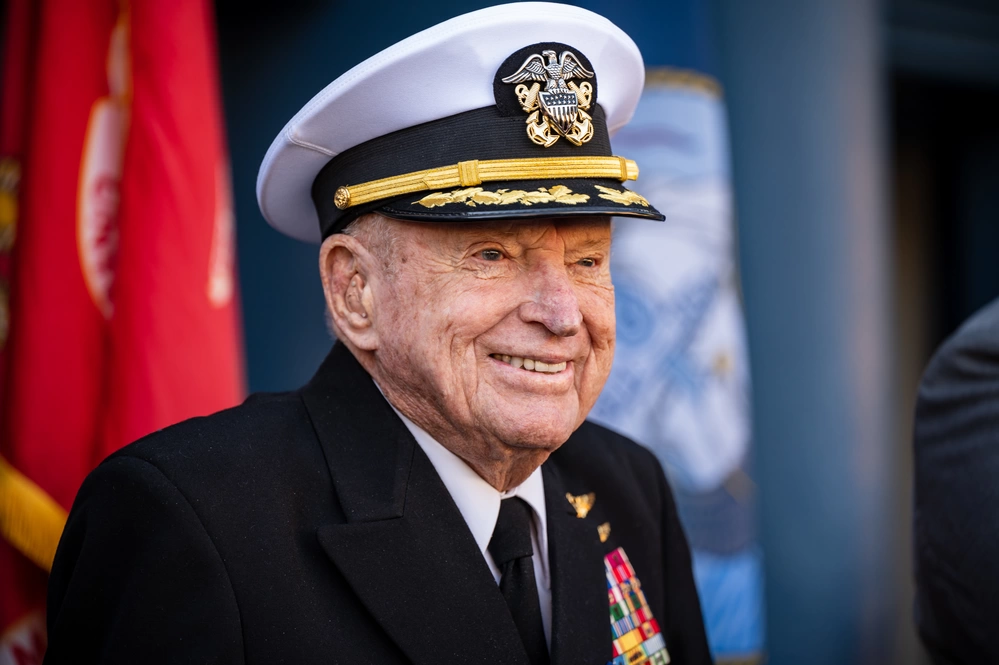
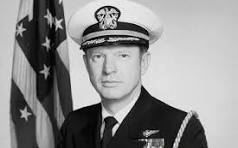
Captain Elmer Royce Williams served the United States Navy for 37 years, flying combat missions in three wars. He accumulated 4,500 flight hours,3,000 on jets and 1,500 on propeller aircraft,and made 518 carrier landings.
Early Life
Elmer Royce Williams was born on April 4, 1925, in Wilmot, South Dakota, a small town near the Minnesota border. He grew up in Wilmot and neighboring Clinton, Minnesota, where he developed the character and determination that would define his military career.
Williams earned the rank of Eagle Scout,the highest achievement in the Boy Scouts of America,and served as a corporal in the Minnesota State Guard before entering military service. These early experiences instilled the discipline and leadership qualities he would carry into naval aviation.
Naval Aviation Training
Williams entered the United States Navy in 1943 during World War II and began the demanding path to becoming a naval aviator. He trained on a progression of increasingly capable aircraft: the N3N and N2S biplanes for primary training, the SNV Valiant and SNJ Texan for basic and advanced training, and the SBD Dauntless dive bomber for operational familiarization.
In August 1945, Williams earned his Wings of Gold at Naval Air Station Pensacola, Florida,the “Cradle of Naval Aviation”,qualifying as a naval aviator just as World War II drew to a close.
Early Fleet Service
Following his qualification, Williams deployed aboard some of the Navy’s premier carriers. He served on USS Franklin D. Roosevelt (CVB-42) and USS Princeton (CV-37), flying three of the Navy’s frontline fighters: the F6F Hellcat, the F4U Corsair, and the F8F Bearcat. He rotated through multiple fighter squadrons including VBF-81, VBF-98, VF-81, VF-13A, and VF-131, gaining broad tactical experience across different aircraft and operational environments.
Williams also pursued his education during this period. He attended the University of Minnesota from 1949 to 1950, earning his Bachelor of Arts degree, followed by graduate studies at the Naval Postgraduate School in Monterey, California in 1951,preparing him for the senior leadership roles that lay ahead.
Korean War
The Korean War brought Williams into the jet age. He deployed aboard USS Oriskany (CVA-34) with Fighter Squadron 781 (VF-781) and later aboard USS Boxer (CV-21) with VF-121, flying the Grumman F9F Panther,the Navy’s first successful carrier-based jet fighter. Over the course of his Korean War deployments, Williams completed 70 combat missions.
It was during this period, on November 18, 1952, that Williams engaged in the aerial battle that would eventually earn him the Medal of Honor,a solo engagement against seven Soviet MiG-15 fighters that lasted approximately 35 minutes and resulted in four enemy aircraft destroyed. The full account is detailed on the Battle page.
The engagement was immediately classified, and Williams was sworn to secrecy. He would not speak of the true nature of this battle for more than fifty years.
Post-Korea & Advanced Training
Following Korea, Williams continued to fly the most advanced fighters in the American arsenal. He was stationed at Nellis Air Force Base in Nevada from 1954 to 1956, where he flew the swept-wing F-86 Sabre and the supersonic F-100 Super Sabre,transitioning from the subsonic jets of Korea to the century-series fighters that would define Cold War air combat.
In 1957, while stationed at Naval Air Facility El Centro, California, Williams survived a serious crash in an FJ-3 Fury caused by engine failure, suffering back and neck injuries that would affect him for the remainder of his career. Despite these injuries, he continued to fly.
He attended the Joint Forces Staff College in Norfolk, Virginia in 1958, preparing for joint-service leadership. From 1959 to 1960, he served with VF-173 aboard USS Intrepid (CVS-11) and USS Independence (CVA-62) as Assistant Air Operations Officer, flying the FJ-3. He then transitioned to the F-8E Crusader with VF-124,one of the Navy’s premier supersonic fighters,and spent two years supervising officer promotions at the Bureau of Naval Personnel in Washington.
Fighter Squadron Command
After completing Fleet Replacement Squadron training with VF-174, Williams took command of Fighter Squadron 33 (VF-33),the “Tarsiers.” As Commanding Officer, he led the squadron flying the F-8E Crusader off USS Enterprise (CVAN-65),the world’s first nuclear-powered aircraft carrier,and the F-4B Phantom II off USS America (CVA-66). This command marked his transition from accomplished fighter pilot to squadron leader, responsible for the training, readiness, and combat effectiveness of an entire fighter squadron.
Vietnam War
Williams’ second war as a combat aviator came in Vietnam. From December 1965 to January 1967, he commanded Carrier Air Wing Eleven (CVW-11) aboard USS Kitty Hawk (CVA-63), one of the Navy’s premier attack carriers operating on Yankee Station in the Gulf of Tonkin.
As CAG (Commander, Air Group), Williams flew 110 combat missions himself,leading from the front in both A-4 Skyhawk light attack aircraft and F-4 Phantom II fighters. He personally planned and led aerial strikes against heavily defended North Vietnamese targets, earning two Distinguished Flying Crosses for his valor. On April 17, 1966, he flew in the van of an attacking force against a major target despite intense anti-aircraft fire, personally silencing enemy gun batteries to enable the mission’s success.
During this deployment, Williams also survived a harrowing incident when both engines of his F-4 Phantom caught fire. While his radar intercept officer ejected, Williams brought the stricken aircraft back to base,a decision that allowed engineers to identify and correct a systemic twin-engine fire problem that could have affected the entire fleet.
Senior Leadership
Following Vietnam, Williams moved into the highest levels of Navy leadership. He served on the Chief of Naval Operations staff in Washington, D.C., where he was appointed Director of POW/MIA Matters,a role of extraordinary sensitivity during the Vietnam era. In this capacity, he supervised the repatriation efforts following the capture of USS Pueblo (AGER-2) by North Korea in January 1968 and the shoot-down of a Navy EC-121 reconnaissance aircraft by North Korean fighters in April 1969.
Williams then took command of USS Eldorado (AGC-11), an amphibious force command ship, demonstrating his versatility as a leader beyond aviation. He subsequently served on the CINCPAC (Commander in Chief, Pacific) staff at Camp H.M. Smith in Hawaii, and as Chief of Staff for Commander, Fleet Air, Western Pacific,overseeing naval aviation operations across the Pacific theater.
In 1975, while serving as Assistant Chief of Staff for Operations with the Training Command, Pacific Fleet, Williams was placed on the Temporary Disability Retired List due to the back injuries he had sustained in his 1957 crash at El Centro.
Retirement
Captain Elmer Royce Williams officially retired from the United States Navy in January 1980, concluding 37 years of service that spanned three wars, dozens of aircraft types, and nearly every level of naval command from fighter pilot to air wing commander to ship captain to theater staff officer.
He settled in Escondido, California, where he became an active member of American Legion Post 416. True to his character, Williams lived quietly in retirement,still honoring the secrecy oath he had taken in 1952. It would not be until Korean War records were declassified around 2002 that the true scope of his most remarkable achievement would begin to emerge.
Sources
- Royce Williams,Wikipedia
- Elmer Royce Williams,Military Times Hall of Valor
- Elmer R. Williams,Congressional Medal of Honor Society
- Captain Royce Williams,Medal of Honor,American Legion Post 416
- Krylov, Leonid & Tepsurkaev, Yuriy. Red Devils over the Yalu: A Chronicle of Soviet Aerial Operations in the Korean War 1950–53. Helion & Company, 2014.
- American Legion Magazine, November 2017 cover story.
- Congressman Darrell Issa,Royce Williams,U.S. House of Representatives
By the Numbers
| Years of Service | 37 |
| Final Rank | Captain (O-6) |
| Total Flight Hours | 4,500 |
| Jet Hours | 3,000 |
| Prop Hours | 1,500 |
| Carrier Landings | 518 |
| Korea Missions | 70 |
| Vietnam Missions | 110 |